The Main Types of Valves Explained
INTRODUCTION: WHY THERE ARE SO MANY VALVE TYPES
If you’re new to valves, one of the first things you’ll notice is just how many different types exist. That isn’t overengineering — it’s necessity. Different systems handle different pressures, temperatures, flow rates, and media, and each valve design is optimised for a specific job.
Some valves are built purely to shut flow on or off. Others are designed to regulate flow precisely, prevent backflow, or protect equipment from dangerous pressure build-up. Understanding the main valve types gives you a solid foundation for selecting the right valve and avoiding costly mistakes.
BALL VALVES
Ball valves are one of the most widely used valve types in industry. They use a drilled, rotating ball to control flow. When the hole in the ball aligns with the pipeline, flow passes freely. Rotate it 90 degrees, and flow stops completely.
They are valued for fast operation, tight shut-off, and reliability. Because they open and close quickly, ball valves are best suited for on/off service rather than fine control. You’ll commonly find them in water systems, gas lines, compressed air, and many process applications.
BUTTERFLY VALVES
Butterfly valves control flow using a rotating disc mounted in the centre of the pipe. As the disc turns, it either restricts or allows flow. Their compact design makes them especially popular in large-diameter pipelines where space and weight matter.
They are widely used in water treatment, HVAC systems, fire protection, and industrial process lines. Modern high-performance and triple-offset butterfly valves can also handle higher pressures and temperatures, extending their use into more demanding applications.
GATE VALVES
Gate valves use a sliding gate or wedge to start or stop flow. When fully open, the gate lifts completely out of the flow path, resulting in minimal pressure drop. This makes gate valves ideal for applications where uninterrupted flow is required.
They are not designed for throttling. Partially opening a gate valve can cause vibration and erosion, shortening its lifespan. Gate valves are commonly used in isolation duties within water, oil, and steam systems.
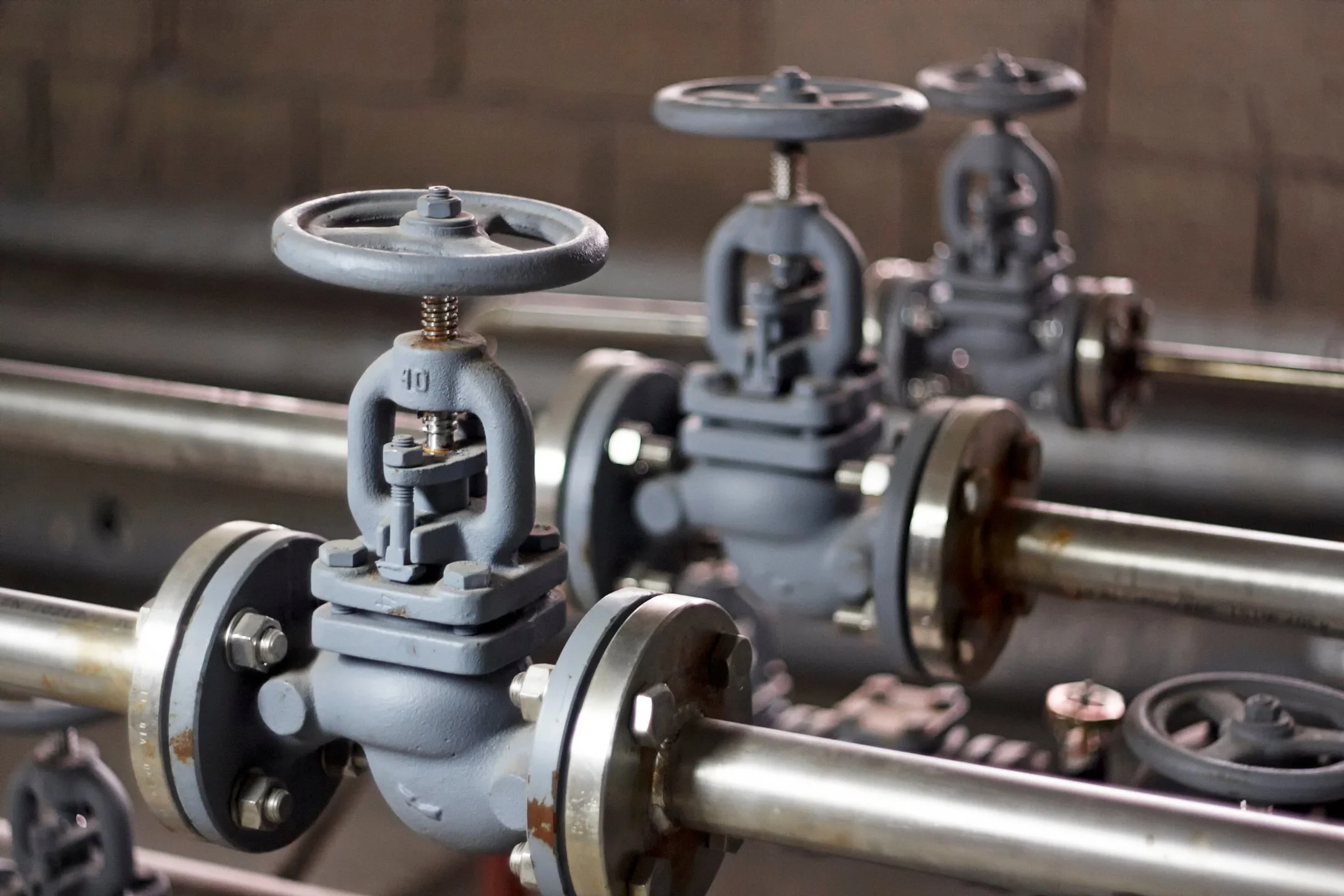
GLOBE VALVES
Globe valves are designed specifically for flow regulation. Their internal design forces fluid to change direction, allowing precise control over flow rate. This makes them ideal for applications where control is more important than efficiency.
They are frequently used in control systems, boiler feedwater lines, and process industries where accurate modulation is required. The trade-off is higher pressure drop compared to ball or gate valves.
CHECK VALVES
Check valves allow flow in one direction only. They operate automatically, opening when flow moves forward and closing if flow reverses. This protects pumps, compressors, and other equipment from damage caused by backflow.
Common designs include swing check valves, lift check valves, and dual-plate check valves. They are essential in systems where reverse flow could cause contamination, pressure spikes, or mechanical failure.
WHY VALVE TYPE MATTERS
Each valve type solves a specific problem. Choosing based on size alone isn’t enough. Flow control needs, pressure ratings, operating frequency, and media characteristics all play a role.
Understanding the main types of valves helps you design safer systems, reduce maintenance, and improve overall performance. The right valve doesn’t just control flow — it protects the entire system.