Valve Sizing Explained: How to Avoid Undersizing or Oversizing

INTRODUCTION: WHY VALVE SIZING REALLY MATTERS
Valve sizing is one of the most misunderstood parts of valve selection. Many issues blamed on “poor valve quality” are actually caused by incorrect sizing. A valve that is too small struggles to deliver flow. A valve that is too large loses control and wears prematurely. Either mistake leads to inefficiency, noise, instability, and reduced service life.
Correct valve sizing ensures stable flow, predictable control, low energy loss, and long-term reliability. To get it right, you need to understand flow rates, Cv values, and pressure drop — and how they interact in real systems.
FLOW RATE: THE FOUNDATION OF VALVE SIZING
Every sizing decision starts with flow rate. This is the volume of fluid that must pass through the valve over time, usually expressed in m³/h, l/s, or gpm. If the required flow is underestimated, the valve will restrict the system. If it’s overestimated, the valve may never operate in its optimal range.
Valves are designed to perform best when operating within a controlled mid-range of their travel, not fully open or nearly closed. Correct sizing allows the valve to regulate flow smoothly without forcing extreme positions.
Flow rate is not a guess — it should always be based on actual system demand.
CV VALUE EXPLAINED (AND WHY IT MATTERS)
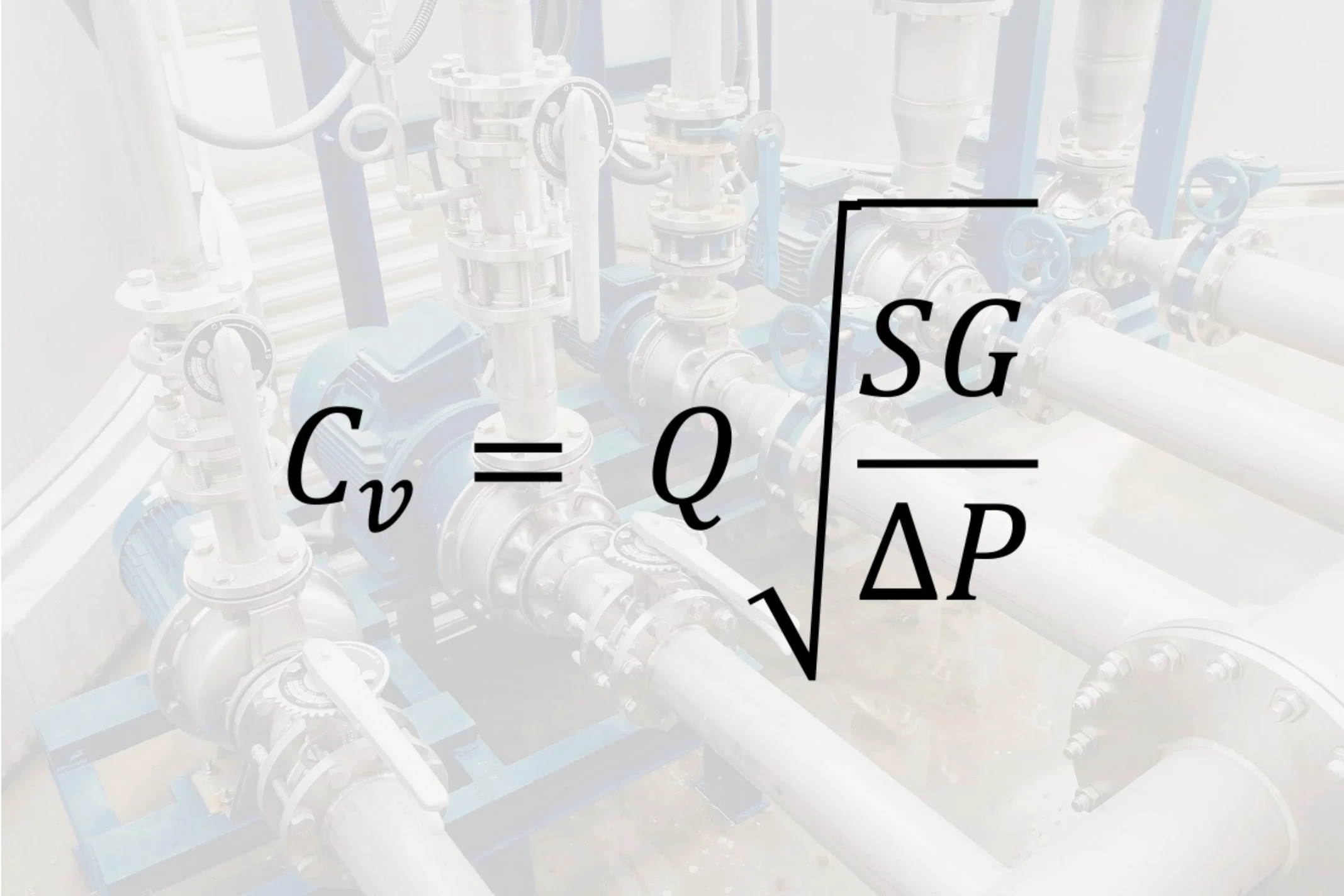
The Cv value is one of the most important sizing parameters. Cv represents the flow capacity of a valve — specifically, how much fluid can pass through the valve at a given pressure drop.
A valve with too low a Cv will choke the system, creating excessive pressure loss. A valve with too high a Cv will pass too much flow with very little movement, making control unstable. This is especially critical for control valves, where precision matters.
Correct sizing means selecting a valve where the required flow occurs at a sensible valve opening, not at the extremes.
PRESSURE DROP: THE HIDDEN CONSEQUENCE
Pressure drop is the loss of pressure as fluid flows through a valve. Some pressure drop is necessary for control, but too much causes inefficiency and stress on the system.
An undersized valve creates excessive pressure drop, forcing pumps or compressors to work harder. This increases energy consumption and operating costs. Oversized valves, on the other hand, produce very little pressure drop, which leads to poor control authority and unstable operation.
Balanced pressure drop is key to quiet, efficient systems.
WHAT GOES WRONG WITH INCORRECT SIZING

Incorrect valve sizing causes a range of real-world problems. Undersized valves often generate noise, vibration, erosion, and cavitation, especially in high-pressure applications. Oversized valves tend to “hunt,” opening and closing rapidly, which accelerates seat and trim wear.
In control applications, oversizing is particularly damaging. A valve that is too large cannot control flow accurately, leading to temperature swings, unstable pressure, and inconsistent performance.
Most valve failures start with a sizing mistake.
HOW TO AVOID UNDERSIZING AND OVERSIZING
The best way to avoid sizing errors is to base decisions on real operating data. This includes maximum and minimum flow, operating pressure, temperature, and fluid properties. Safety margins are important, but excessive oversizing is not a safety factor — it’s a problem.
Correct valve sizing ensures smooth control, longer service life, reduced maintenance, and lower energy use. It’s not about choosing the biggest valve — it’s about choosing the right one.
CONCLUSION: SIZE FOR PERFORMANCE, NOT ASSUMPTIONS
Valve sizing is a balance between flow, pressure drop, and control stability. When done correctly, the valve becomes almost invisible in operation. When done poorly, it becomes the weakest link in the system.
Understanding flow rates, Cv values, and pressure drop is the key to avoiding noise, wear, and poor control — and building systems that perform exactly as intended.