Rack & Pinion vs Scotch Yoke Actuators Explained
INTRODUCTION: TWO DESIGNS, TWO VERY DIFFERENT APPROACHES
Rack & pinion and scotch yoke actuators are the two most common mechanisms used to automate quarter-turn valves such as ball, butterfly, and plug valves. At a glance they do the same job — converting linear motion into rotary motion — but how they generate torque, how they behave through the stroke, and where they perform best are very different.
Understanding the difference between these two actuator types is critical for correct valve operation, long service life, and reliable shut-off. This guide explains how each design works, their strengths and limitations, and how to choose the right one for your application.
HOW RACK & PINION ACTUATORS WORK
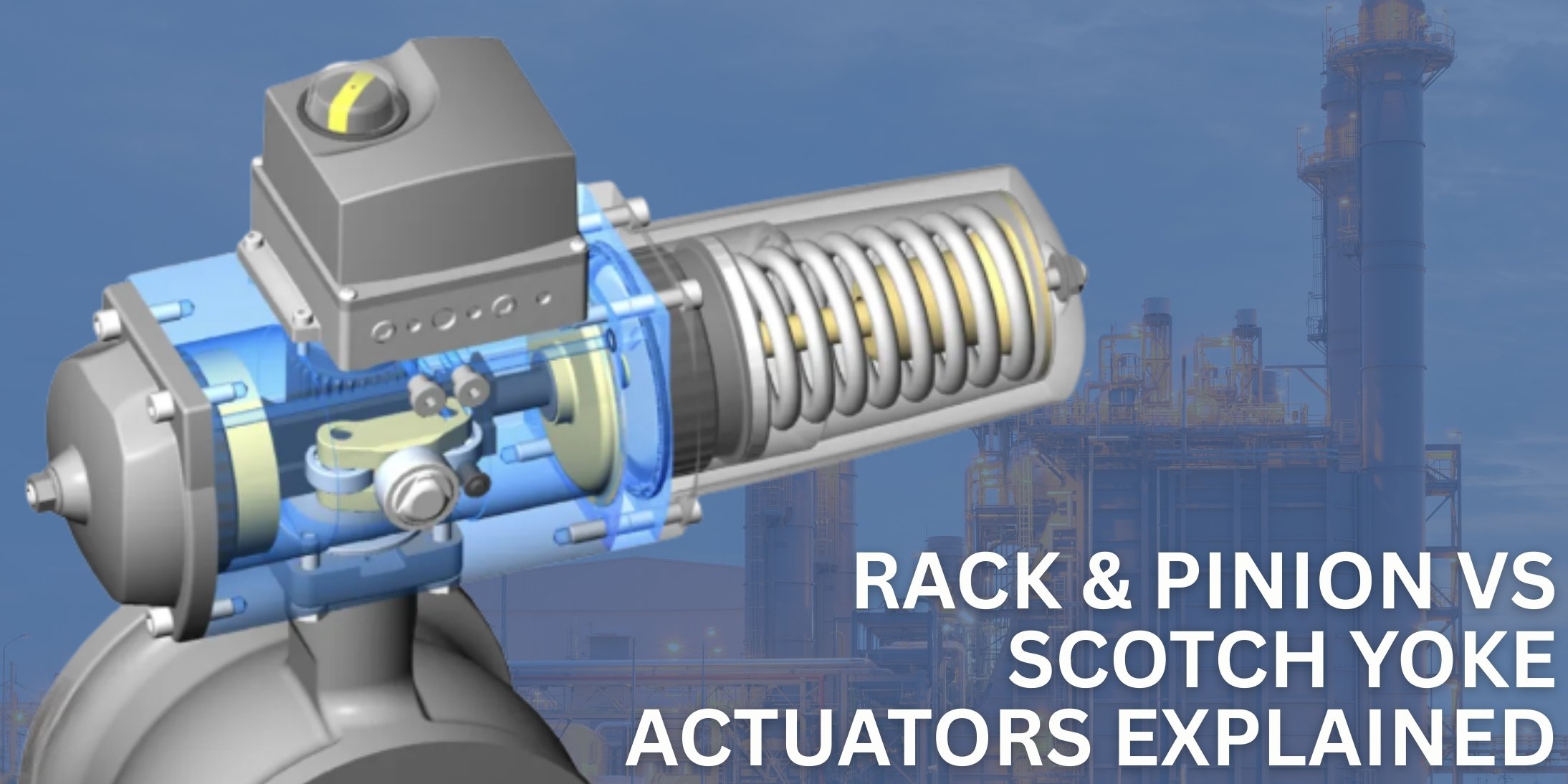
Rack & pinion actuators use one or two pistons connected to toothed racks. As air pressure is applied, the pistons move linearly, driving the racks across a central pinion gear. This rotation is transferred directly to the valve shaft, opening or closing the valve.
The key characteristic of a rack & pinion actuator is its balanced torque output. Torque remains relatively consistent throughout the full 90-degree stroke, making this design ideal for valves that require similar torque at the start, middle, and end of travel.
Rack & pinion actuators are compact, lightweight, and widely used across general industrial applications. Their modular design also makes them easy to accessorise with solenoids, positioners, and switchboxes.
HOW SCOTCH YOKE ACTUATORS WORK
Scotch yoke actuators use a very different mechanism. Instead of gears, they rely on a sliding yoke connected to a piston. As the piston moves, the yoke pushes against a pin attached to the output shaft, converting linear motion into rotation.
The defining feature of a scotch yoke actuator is its torque curve. It delivers very high torque at the beginning and end of the stroke, with lower torque through the mid-position. This makes scotch yoke designs particularly effective for valves that need a strong breakaway force to open or a high seating force to close.
Because of this torque profile, scotch yoke actuators are commonly used on large ball valves, high-pressure systems, and severe service applications.
TORQUE CHARACTERISTICS AND PERFORMANCE
Torque behaviour is the biggest practical difference between these two actuator types. Rack & pinion actuators provide smooth, even torque, which suits smaller to medium-sized valves and applications requiring consistent modulation.
Scotch yoke actuators excel where valves are difficult to operate due to pressure, friction, or tight sealing requirements. Their ability to deliver peak torque exactly when it is needed makes them highly reliable in demanding environments.
Choosing the wrong torque profile can lead to slow operation, incomplete shut-off, or excessive wear on valve seats and seals.
WHICH SHOULD YOU CHOOSE?
Rack & pinion actuators are typically chosen for compact installations, lighter valves, and applications where space, weight, and cost efficiency are important. They are the go-to option for most standard automated valve packages.
Scotch yoke actuators are preferred for heavy-duty service, high torque demands, and critical isolation duties. While they are usually larger and heavier, they provide confidence where valve operation cannot be compromised.
The right choice depends on valve type, required torque, operating pressure, available space, and duty cycle.